Last updated November 18, 2026

Free written scope consultation - allowances, timeline, and change-order rules on paper before a single trade is scheduled
The Complete Bathroom Remodeling Guide for Plano Homeowners
The most expensive mistake in a bathroom remodel isn’t choosing the wrong tile. It’s scheduling the tile setter before the shower pan liner has passed a water test. That single sequencing error means cutting out finished tile to repair a liner failure an inspection would have caught for free. In a Plano bathroom remodel, four licensed trades – plumbing, electrical, tile, and finish carpentry – overlap in dependencies most online guides flatten into a simple checklist. This guide shows the actual dependency map, what each permit triggers, what the numbers look like in Plano, and what breaking the sequence costs.
Quick Answer
A full gut-and-replace of a primary bathroom in Plano typically runs $18,000 to $45,000 depending on fixture tier, shower system, and whether the layout moves. The schedule is driven by three inspection gates – rough plumbing, rough electrical, and shower pan water test – and skipping any of them is what turns an on-budget remodel into a rebuild. A fixture-for-fixture swap usually does not require a plumbing permit; moving a drain does.
Styles & brands we work with
- Kitchen remodeling
- Bathroom remodeling
- Home additions & ADU
- Roofing
- Windows & doors
- Driveway & pavers
- Fence
Table of Contents
- Which Trades in a Plano Bathroom Remodel Require a Permit?
- What Does a Plano Bathroom Remodel Cost?
- The Trade Dependency Map: What Sequence Prevents Failures
- How Plano’s Hard Water Changes Your Material Choices
- The Exhaust Fan Requirement Most Remodels Get Wrong
- Schluter Kerdi vs. Traditional Mud-Bed: Which Shower System Fits
- How Long Does a Plano Bathroom Remodel Take?
Which Trades in a Plano Bathroom Remodel Require a Permit?
Three trades in a bathroom remodel can trigger a permit in Plano: plumbing, electrical, and HVAC. The trigger is almost always relocation or addition, not replacement.
Plumbing. A fixture-for-fixture swap – new toilet on the existing flange, new vanity in the same spot, new shower valve in the same rough-in opening – typically does not require a plumbing permit. It’s a replacement, not an alteration. Move a drain, relocate the toilet, add a second sink, or shift the shower from a tub alcove, and the work now alters the drain-waste-vent system. That requires a permit and a rough-plumbing inspection before the walls close.
Electrical. Replacing a vanity light in the same box is a swap. Adding a dedicated circuit for a heated towel bar, moving a GFCI receptacle, or installing new recessed lighting over the shower triggers a permit and an electrical rough-in inspection. In Plano homes built before about 1990, we regularly find bathroom receptacles without proper GFCI protection; correcting that during a remodel is the right moment and adds a permit line item.
HVAC. If you add an exhaust fan to a bathroom that never had one, or relocate an existing fan to a different wall, that’s mechanical work and it requires a permit. Replacing a fan in the same ceiling cutout with the same CFM rating usually does not.
One practical note. Permit fees in Plano are modest relative to the remodel, but the inspection schedule is what actually affects your calendar. Budget two to five business days between rough inspection request and pass, and do not let any crew close a wall before the sticker is on.
What Does a Plano Bathroom Remodel Cost?
Here is the range we quote most often in Plano, broken into tiers by fixture and material grade. These are full gut-and-replace numbers for a primary bath in the 50 to 80 square foot range, including demolition, substrate repair, tile, vanity, fixtures, lighting, and finish carpentry.
| Scope | Low | Mid | High |
|---|---|---|---|
| Primary bath gut-and-replace (50-80 sq ft) | $18,000-$24,000 | $26,000-$34,000 | $36,000-$45,000 |
| Hall bath gut-and-replace (35-50 sq ft) | $12,000-$17,000 | $18,000-$24,000 | $26,000-$32,000 |
| Shower system only (tile-in shower) | $6,500-$9,000 | $9,500-$14,000 | $15,000-$22,000 |
| Vanity and top replacement | $1,800-$3,200 | $3,500-$6,000 | $6,500-$11,000 |
| Layout change (drain/water relocation adds) | $2,500-$4,000 | $4,500-$7,000 | $8,000-$12,000 |
At each tier, the brands are what separate the number:
- Low tier. Sterling or a builder-grade Sterling/Kohler line for the shower base and toilet, Delta or Moen single-handle valve, porcelain tile with a traditional PVC liner shower pan, painted MDF vanity with a cultured marble top.
- Mid tier. Kohler fixtures throughout, Moen or Delta with a thermostatic valve, porcelain or ceramic tile over a Schluter Kerdi waterproofing system, semi-custom vanity with a quartz top.
- High tier. Kohler or Grohe fixtures, thermostatic valve with volume control, large-format porcelain or natural stone over Schluter Kerdi-Board, frameless glass enclosure, full-height tile, custom cabinetry with a quartz or stone top.
Roofing and exterior materials aren’t part of a bathroom number, but if you’re planning a broader renovation, GAF and Owens Corning shingle lines run through our Rowan Construction Group Plano home page alongside the interior work.
The Trade Dependency Map: What Sequence Prevents Failures
This is the section most guides skip. A bathroom remodel isn’t a list of trades worked one after another; it’s a dependency chain where one trade’s inspection gates the next trade’s start. Break the chain and you pay twice.
- Demolition and substrate inspection (days 1-2). Remove tile, fixtures, and vanity. Expose the framing and subfloor. Document what’s actually there – rot at the tub surround, a soft subfloor around the toilet flange, water staining at the shower curb.
- Rough plumbing and rough electrical (days 3-5). Relocate drains, set the new shower valve, run the dedicated circuits. Both trades rough in on the same days; neither closes a wall.
- Rough inspections (days 6-8). Plumbing and electrical inspect on separate line items. Nothing closes until both pass. This is the gate most schedule collapses come from.
- Shower pan and waterproofing (days 9-11). Pre-slope, liner (or bonded membrane if using Schluter Kerdi), curb, and flood test. The flood test holds water 24 hours minimum. Do not skip it.
- Flood test verification and tile substrate (days 12-13). Confirm the water level held. Set cement board or Kerdi-Board, tape and thinset the seams, and let the substrate cure.
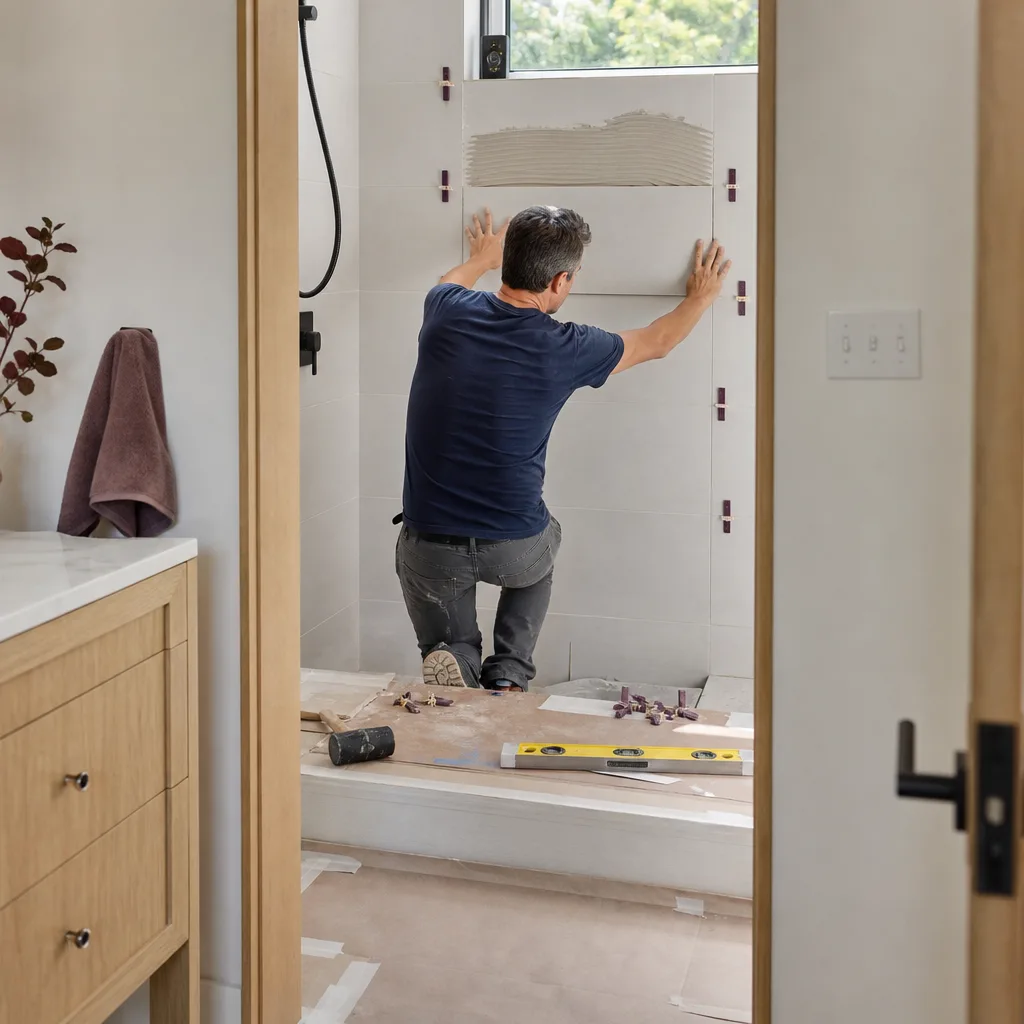
- Wall tile (days 14-18). Set wall tile first, then floor. Mortar needs 24 hours before grout, and grout needs 24 to 48 hours before heavy fixtures go back in.
- Vanity, toilet, and trim (days 19-22). Set the vanity and top, install the toilet on the finished floor, run baseboard and door trim, hang the mirror and lighting.
- Glass enclosure template and install (day 22 or later). Glass is templated after tile is final, then fabricated and installed. That’s typically 5 to 10 business days between template and install. Setting glass against green mortar or wet grout is how enclosures crack.
The minimum gap that matters most: rough inspection to shower flood test is one business day; flood test to tile is one full day of holding water; tile to glass is the fabrication window. Budget those and your schedule holds. Skip the flood test and you’re pulling finished tile off a failed liner, which in Plano we quote at $4,000 to $8,000 to correct on top of the original build.
How Plano’s Hard Water Changes Your Material Choices
North Texas municipal water runs hard – typically 15 to 20 grains per gallon on the hardness scale in Plano, depending on the season and the source blend. That number has direct consequences on what you should put in a bathroom.
Fixture finishes. Polished chrome and polished nickel show water spotting in a few days at this hardness. Brushed finishes – brushed nickel, matte black, satin brass – camouflage mineral film far better and are worth the modest upcharge. Chrome remains the easiest to clean because it’s non-porous; it just requires more frequent wiping. Choose based on how you actually maintain a bathroom, not how the showroom looks.
Grout. Cementitious grout in a shower with 18-grain water will stain within months. Epoxy grout or a sealed cement grout is the right call in a Plano shower, and we specify epoxy as standard in the wet zone. On floors where staining is lighter, sealed cement grout holds up fine.
Glass. Untreated glass in a hard-water bathroom develops mineral etching that no cleaner removes once it sets. A hydrophobic coating applied at install, plus a squeegee habit, is the difference between a clear enclosure at year three and a cloudy one.
Tile. Porcelain is less porous than ceramic and tolerates hard water better in a wet zone. Large-format porcelain reduces grout line count, which reduces staining surface area – a real benefit in Plano bathrooms, not a design flourish.
The Exhaust Fan Requirement Most Remodels Get Wrong
Texas residential code requires a bathroom exhaust fan in any bathroom without an operable window. The minimum airflow rating scales with room size: roughly 50 CFM for bathrooms up to 50 square feet, 80 CFM for 50 to 100 square feet, and 100 CFM or more above that. The number to remember isn’t the fan; it’s the termination.
In Plano homes built in the 1980s and 1990s, we regularly find exhaust fans that terminate into the attic – dumping moist air directly into the insulation and roof sheathing – rather than ducting to the exterior. That’s a correction, not an upgrade, and it belongs in the scope of a bathroom remodel. The consequences of leaving it: sheathing rot, mold in the attic, and premature roof failure.
Ducts must run to the exterior with a proper roof or wall cap, insulated where they pass through unconditioned attic space, and as short and straight as the layout allows. A fan rated at 80 CFM that travels fifteen feet through a flex duct is delivering far less than 80 CFM at the grille. Size the fan and the duct together. If the fan is added or relocated, it’s mechanical work and it needs a permit.
Schluter Kerdi vs. Traditional Mud-Bed: Which Shower System Fits
Two shower construction methods dominate in Plano, and the choice affects cost, schedule, and failure risk.
Traditional mud-bed with PVC liner. A sloped mortar bed, a PVC pan liner up the walls to code minimum, cement board over the liner with a moisture barrier, then tile. It works when built correctly, but the liner is the weak point: a single fastener through the liner at the curb, a fold that’s not sealed, or a weep hole blocked at the drain and water sits in the mortar bed. This method requires a flood test – hold water 24 hours – because the liner can’t be inspected once it’s buried.
Bonded waterproofing (Schluter Kerdi). A sheet-applied membrane bonded directly to the substrate with thinset, with a pre-formed shower pan, curb, and drain flange. The waterproofing layer sits directly beneath the tile, so water drains at the tile surface and there’s no mortar bed to saturate. The trade-off is price – bonded membrane systems typically add $1,500 to $3,000 to a shower build over traditional – and it has its own discipline: every seam must overlap correctly and every thinset edge must be embedded.
Which to choose? In Plano’s hard water, bonded membrane is our default for a primary shower. It’s easier to maintain, it eliminates the saturated-mortar-bed failure mode, and the drain assembly is more straightforward. Traditional mud-bed still makes sense on lower-tier scope or a simple tub surround where the liner is fully protected. Either way, the flood test is not optional. Schluter Kerdi doesn’t skip the test just because the manufacturer warrants the system.
How Long Does a Plano Bathroom Remodel Take?
A typical Plano bathroom remodel runs six to eight weeks from demolition to final walkthrough, with the shower glass fabrication window often the longest single delay. A hall bath without layout changes can run four to five weeks. A primary bath with a drain move and a custom vanity often runs eight to nine weeks, and a full primary with layout change, plumbing and electrical relocation, and glass can stretch to ten weeks. The variable that most often pushes a project past its estimate is inspection turnaround – not labor. Get the permit pulled the week before demo, not during it. That single administrative step saves a week in most Plano remodels.
Common Mistakes to Avoid
- Setting tile before the shower pan flood test. The liner test is a 24-hour water hold for a reason. In Plano, we’ve seen tile set on untested liners three times in the last two years; each turned into a $5,000-plus rebuild.
- Choosing a bathroom vanity before rough-in is measured. A vanity with an undermount sink needs the rough plumbing centered per the cabinet, not the room centerline. Order the cabinet after rough plumbing, not before.
- Ignoring the exhaust fan termination. A fan ducting into the attic is not a fan, it’s a moisture pump. Put the duct termination in the written scope, not in a change order.
- Reusing old shutoff valves because they “still work.” A 25-year-old valve behind a new vanity is a call waiting to happen. Replace angle stops and supply lines while the wall is open – they’re inexpensive and the labor is already there.
- Setting glass against fresh grout. Glass installers need final tile and cured grout; installing glass on wet mortar traps moisture and stresses the panel. Wait the full cure.
- Assuming a fixture swap needs a permit when it doesn’t – or assuming it doesn’t when it does. Swapping a vanity light is not a permit. Moving the same light to a new location is. Ask before you schedule, not after.
- Skipping the written line-item quote and signing a “roughly” number. A bathroom is where change orders proliferate because surprises live behind the tile. If the quote doesn’t itemize the substrate repair and the glass, you can’t compare it against anything.
See the difference
 Before
 After
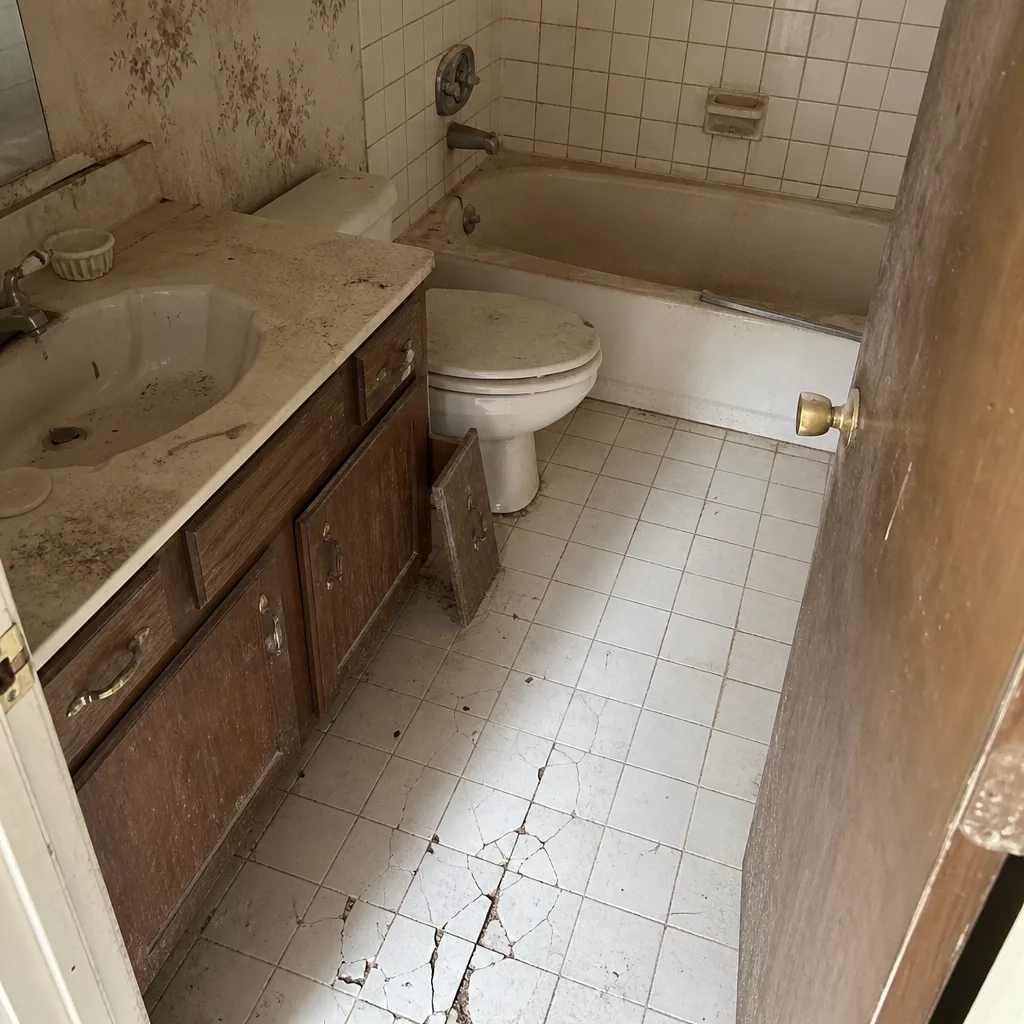 Before
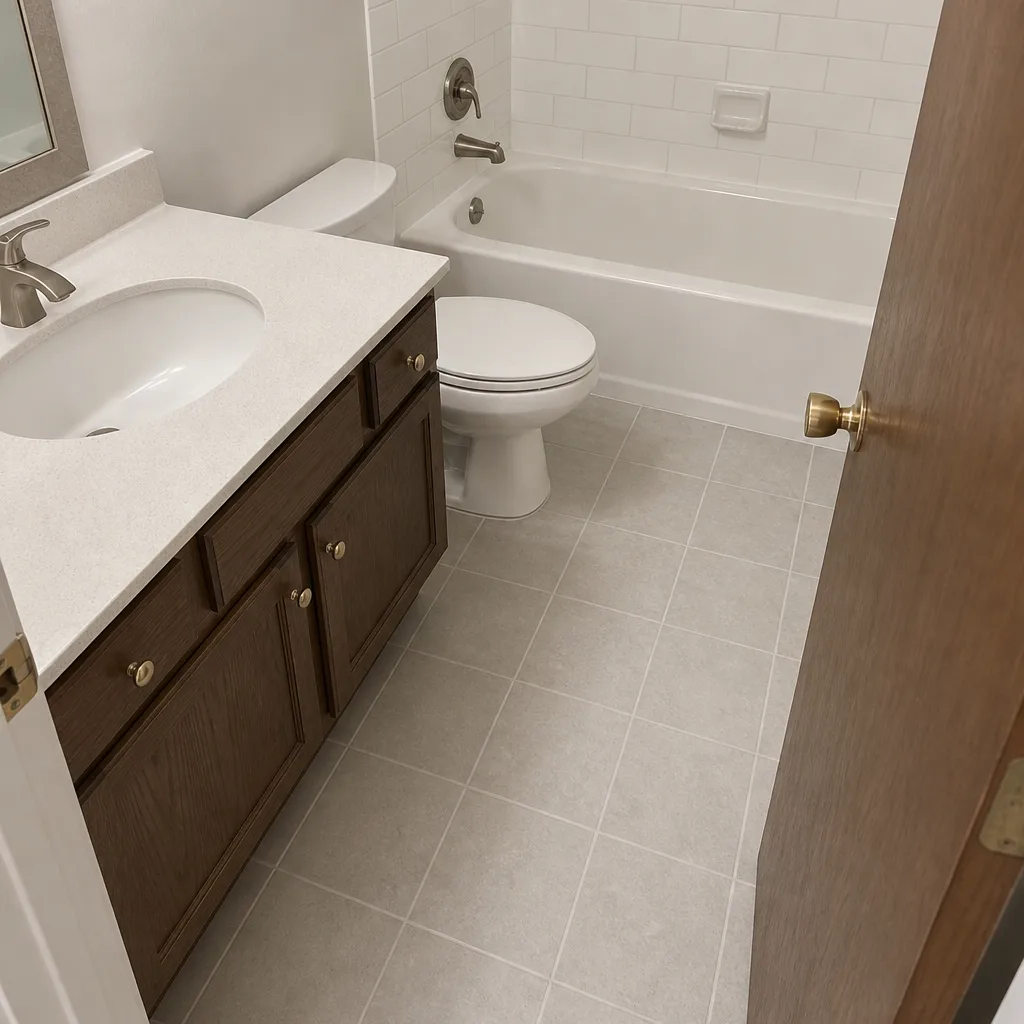 After
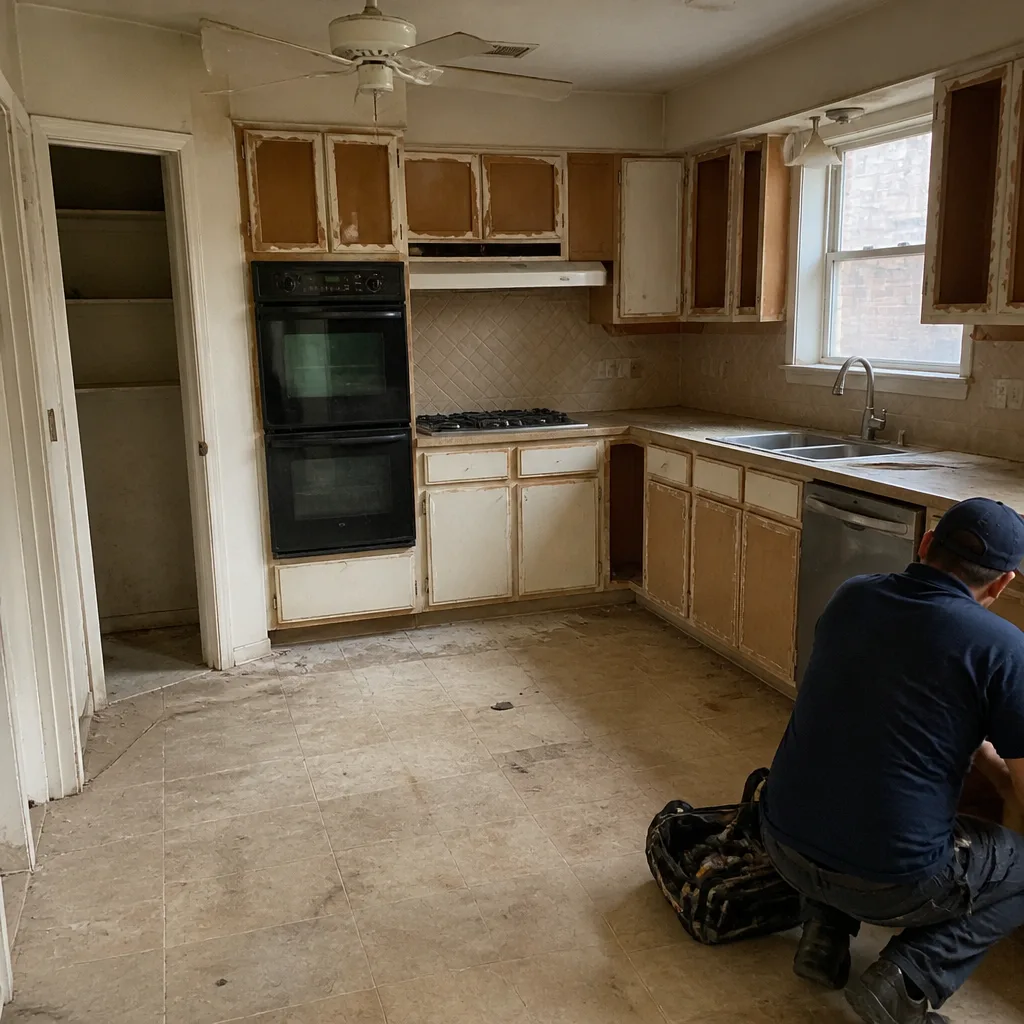 Before
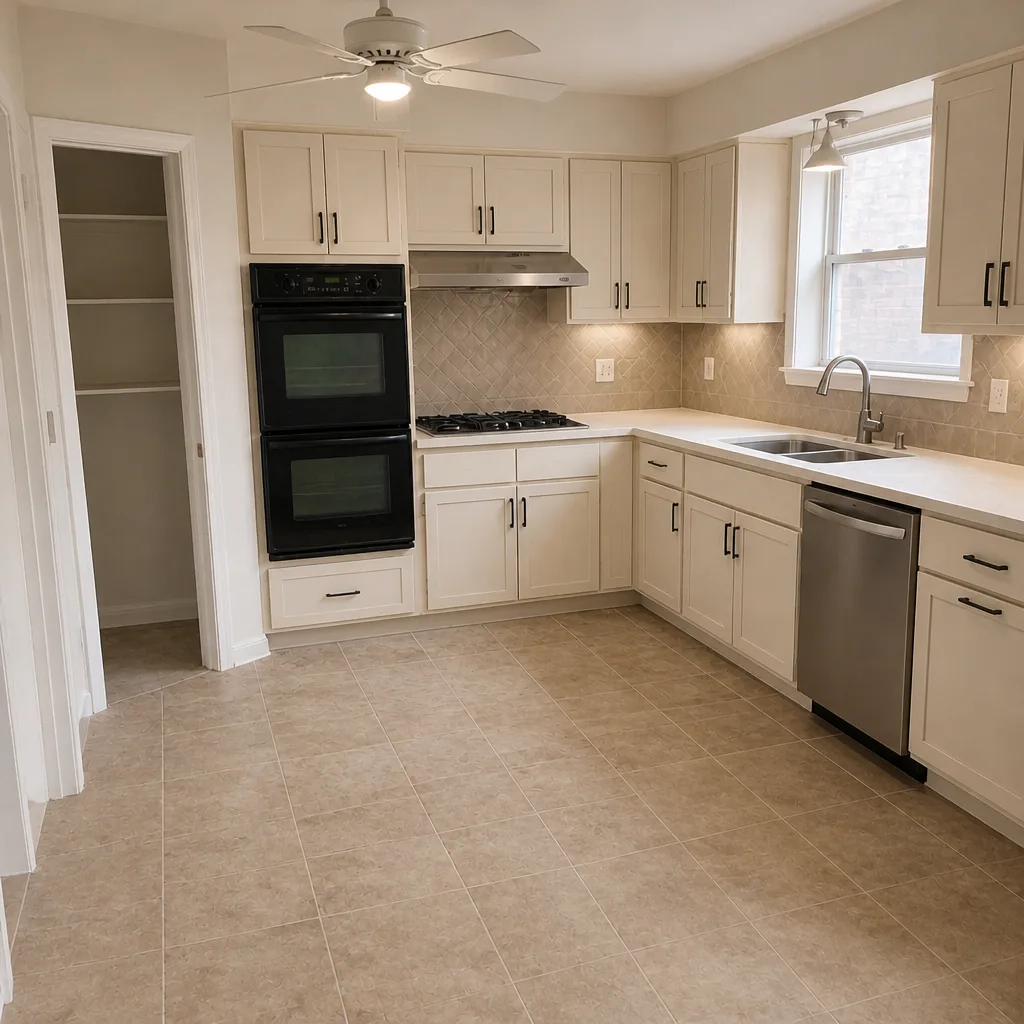 After
When to Call a Professional
Some work belongs to a licensed trade, full stop. If the plan involves moving a drain, relocating the toilet, adding a circuit, running a new exhaust fan, or building a shower pan, those are the exact triggers for permits and licensed work – and they’re what makes a bathroom remodel a coordinated project rather than a weekend job. Reach out when the substrate under the tile is soft, when a shower has leaked into the ceiling below, or when the scope crosses trade lines. Rowan Construction Group Plano offers free estimates in Plano with a written, line-item price before any work starts; call (844) 761-8346. If you’re comparing quotes, our second-opinion review will read a competitor’s estimate line by line at no charge. And if your broader plan includes an addition or a separate structure at the back of the house, our Home Additions & ADU in Plano page shows how those trades coordinate with the interior work.
Frequently Asked Questions
A full gut-and-replace of a primary bathroom in Plano typically runs $18,000 to $45,000, with most jobs landing in the $26,000 to $34,000 range. Hall baths run $12,000 to $32,000 depending on fixture tier. Call (844) 761-8346 for an exact quote on your bathroom – estimates are free and written before any work starts.
A fixture-for-fixture swap usually does not require a permit; moving a drain, adding a circuit, or adding an exhaust fan does. When work alters plumbing, electrical, or mechanical systems, Plano requires the permit and inspection before the wall closes. Call (844) 761-8346 and we’ll tell you which category your scope falls into during the estimate.
Six to eight weeks is the norm for a full primary bath, four to five weeks for a hall bath, and up to ten weeks if the layout changes and glass is custom. The shower glass fabrication window is often the longest single delay. Call (844) 761-8346 to schedule your free estimate and we’ll map the schedule against your timeline.
Only if you approve a written change order. Our written quote is a flat price with a written scope, and no work proceeds on a change until the change order is signed – that’s the discipline that keeps projects within a few percent of the agreed cost. Call (844) 761-8346 to review an existing quote or get a new one.
A bonded waterproofing system like Schluter Kerdi is our default for a primary shower in Plano because it eliminates the saturated-mortar-bed failure mode and pairs well with epoxy grout, which resists the 15 to 20 grain hardness of local water. Traditional mud-bed with a PVC liner remains viable on lower-tier scope. Call (844) 761-8346 and we’ll talk through the difference in dollars before you decide.
We do. Permits are pulled in the homeowner’s name at the estimate stage so the inspection schedule runs on the project calendar, not after demolition. That keeps you within the original timeline. Call (844) 761-8346 to schedule your free estimate and we’ll confirm the permit scope for your bath.
The Bottom Line
Plano bathroom remodeling is a coordination problem disguised as a tile decision. The materials matter – Schluter Kerdi over a water-tested pan, epoxy grout for hard water, brushed fixtures for mineral film, a properly terminated exhaust fan. But none of them can outrun a broken schedule. Get the permit the week before demo. Hold the flood test the full 24 hours. Wait for the glass template until tile is final. Get the price in writing with the substrate repair and glass itemized, and get a signed change order before any added work proceeds. Do those five things and the number on the estimate is the number at the end. Our teams bring up to 19 years of experience to every bathroom project in Plano, and the written price arrives before anyone picks up a tool.
Ready to plan your remodel with a written price in hand? Call (844) 761-8346 to schedule your free estimate with Rowan Construction Group Plano. And when the exterior of the house is part of the plan, our Driveway & Pavers in Plano and Fence Installation in Plano pages show how those scopes run alongside bathroom work.
Written by the team at Rowan Construction Group Plano.